
Steven Saylor é um dos mais interessantes cultores do romance histórico na actualidade, concretamente na ficção de temática romana. Tornou-se conhecido graças à série
Roma sub Rosa, onde se acompanha o estertor da República através das aventuras de Gordiano, uma espécie de detective privado
avant la lettre. Com efeito, é difícil de distinguir a linha que separa o romance histórico da narrativa de mistério, nesta
Roma sub Rosa. Gordiano é a personagem principal numa narrativa feita na primeira pessoa. Movimenta-se entre os notáveis do seu tempo: trabalha para Cícero contra Sula, bebe copos com Catulo, deixa-se seduzir por Clódia, priva com César e Cleópatra, é anfitrião de Catilina, incompatibiliza-se com Crasso... E em momento nenhum parece a forçada a narrativa de Saylor. As personagens têm alma, não se limitam a ser manequins numa reconstituição histórica. Aliás este é um dos pontos fortes de Saylor: os seus mistérios são verdadeiras aulas de História Antiga, sem que em momento algum sintamos que nos está a ser dada uma aula. Os dados históricos e culturais fluem naturalmente, num registo "toda a gente sabe isto, mas vamos lá recordar para os mais distraídos" que não viola nunca a hábil verosimilhança narrativa de Saylor.
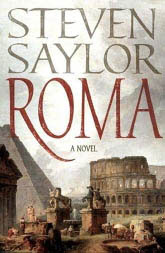
Vem isto a propósito do novo romance de Steven Saylor,
Roma, editado há poucos meses, e ainda não traduzido em Português (mas vai ser, garantiram-me o autor e a tradutora, a doutora Maria José Figueiredo, do Departamento de Filosofia da FLUL). Ainda não o terminei, vou em cerca de metade. Não me está a desiludir. Pelo contrário.
Roma é Saylor no seu melhor. O romance percorre a história de Roma, desde o período anterior à fundação até à morte de César. Saylor recorre a um hábil estratagema que lhe permite contar uma história que dura mil anos, mantendo sempre um fio condutor coerente. A obra está dividida em vários capítulos, histórias aparentemente independentes. O ponto de união é a história de duas famílias patrícias, os Potitii e os Pinarii, e de um talismã que vai passando de geração em geração. Mas isto é apenas o pretexto para um objectivo bastante mais ambicioso: contar alguns dos principais momentos da história de Roma. Sem que, de novo, em momento algum pareça que está a fazer aquilo que de facto está a fazer: dar-nos uma aula magistral sobre a história de Roma, tanto a histórica como a lendária. É assim que no primeiro capítulo, "A stop on the salt route (1000 BC)", se dá conta, por entre uma história de amor, ciúme e morte, da importância estratégica, do ponto de vista comercial, do território que viria mais tarde a ser Roma. No segundo capítulo, "A Demigod passes through (850 BC)", é-nos apresentada uma versão da lenda de Hércules e Caco, e do início do culto de Hércules no território da futura Roma. O terceiro capítulo, "The twins (757-716 BC)", apresenta-nos Rómulo e Remo. Assistimos à ascensão e queda de Rómulo, não de uma perspectiva lendária, mas humana e verosímil quanto baste. O quarto capítulo, "Coriolanus (510-491 BC)", narra, como o título indica, a lenda de Coriolano, bem como a queda da Monarquia e a vitória da República, sem esquecer, como é evidente, o suicídio de Lucrécia. O quinto capítulo, "The twelve tables (450-449 BC)", situa-se durante o governo dos Decênviros, e não esquece a morte de Virgínia às mãos do próprio pai, elemento à volta do qual, de resto, se constrói a narrativa. E mais não digo, pois ainda agora estou a iniciar o sexto capítulo, "The vestal (393-373 BC)".
Além da sua função de entretenimento e fruição estética,
Roma tem evidentes potencialidades didácticas. Estes capítulos podem ser utilizados de forma autónoma, no ensino secundário, como motivação para o estudo das temáticas históricas e culturais neles presentes. Porque, insisto, Saylor é dono de uma erudição assinalável, apresentando a História de Roma com um rigor irrepreensível. Mas sem nunca deixar de o temperar com o seu extraordinário talento de contador de histórias. Um dos mais interessantes no campo do romance histórico.
http://www.stevensaylor.com/


 25 de Julho, 18h 30m
 Steven Saylor, "Roma" (II)
 Steven Saylor é um dos mais interessantes cultores do romance histórico na actualidade, concretamente na ficção de temática romana. Tornou-se conhecido graças à série Roma sub Rosa, onde se acompanha o estertor da República através das aventuras de Gordiano, uma espécie de detective privado avant la lettre. Com efeito, é difícil de distinguir a linha que separa o romance histórico da narrativa de mistério, nesta Roma sub Rosa. Gordiano é a personagem principal numa narrativa feita na primeira pessoa. Movimenta-se entre os notáveis do seu tempo: trabalha para Cícero contra Sula, bebe copos com Catulo, deixa-se seduzir por Clódia, priva com César e Cleópatra, é anfitrião de Catilina, incompatibiliza-se com Crasso... E em momento nenhum parece a forçada a narrativa de Saylor. As personagens têm alma, não se limitam a ser manequins numa reconstituição histórica. Aliás este é um dos pontos fortes de Saylor: os seus mistérios são verdadeiras aulas de História Antiga, sem que em momento algum sintamos que nos está a ser dada uma aula. Os dados históricos e culturais fluem naturalmente, num registo "toda a gente sabe isto, mas vamos lá recordar para os mais distraídos" que não viola nunca a hábil verosimilhança narrativa de Saylor.


